
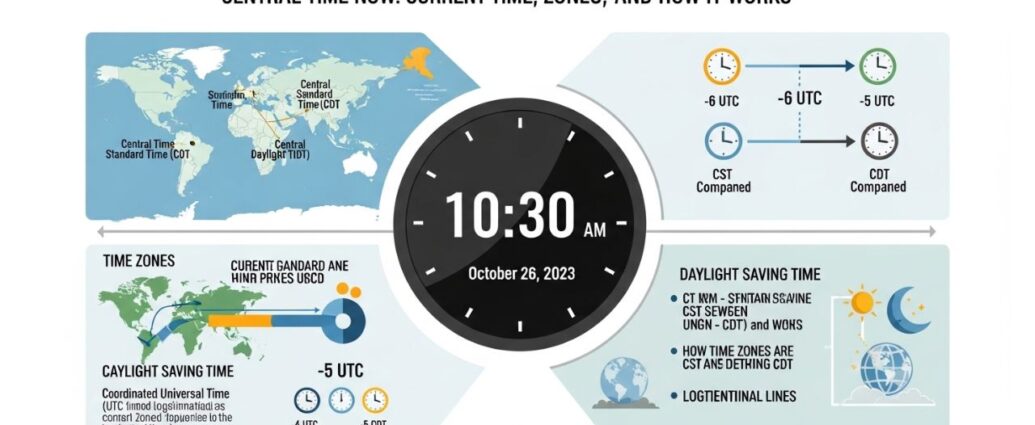
The Ce ntral Tim e Now refers to the current local time observed in the Cen tral Time Zone (CT), which is used by many regions in North America. Ce ntral Time is a key reference for scheduling, travel, business operations, and broadcasting across the United States, Canada, and parts of Mexico. Understanding Cen tral Time is essential for staying on track withappointments, flights, or live events.
What Is Central Time?
Ce ntral Time (CT) is one of the major time zones in North America. It is divided into:
-
Cen tral Standard Time (CST): UTC -6 hours, observed during fall and winter months.
-
Ce ntral Daylight Time (CDT): UTC -5 hours, observed during spring and summer months when daylight saving time is in effect.
This time zone covers a large portion of the United States, including states like Texas, Illinois, Wisconsin, and Louisiana, as well as parts of Mexico and Canada.
Current Central Time Now
The current Ce ntral Tim e now depends on whether daylight saving tim e (DST) is active:
-
During DST (March to November): CDT, UTC -5
-
Outside DST (November to March): CST, UTC -6
For example, if it is 3:00 PM Eastern Ti me (ET), the corresponding Cen tral Time is 2:00 PM CT.
You can always check the current Central Ti me now online through official timekeeping websites or smartphone world clock features.
States and Regions Observing Central Time
The Central Ti me Zone includes a mix of U.S. states that either fully or partially observe CT:
-
Full Central Ti me States: Alabama, Arkansas, Illinois, Iowa, Louisiana, Minnesota, Mississippi, Missouri, Oklahoma, Texas, Wisconsin
-
Partial Central Ti me States: Florida, Indiana, Kansas, Kentucky, Michigan, Nebraska, North Dakota, South Dakota, Tennessee, and more
In Mexico, central states like Mexico City, Puebla, and Veracruz also follow Central Ti me.
How Central Time Differs From Other Time Zones
-
Eastern Time (ET): 1 hour ahead of CT
-
Mountain Time (MT): 1 hour behind CT
-
Pacific Time (PT): 2 hours behind CT
This difference is important for scheduling meetings, flights, or live events across multiple regions.
Daylight Saving Time and Central Time
Centr al Ti me observes daylight saving time:
-
Start of DST: Second Sunday in March (clocks move forward 1 hour)
-
End of DST: First Sunday in November (clocks move back 1 hour)
During DST, Cen ral Tim e is referred to as Cen tral Daylight Time (CDT); otherwise, it remains Cen tral Standard Time (CST).
Why Central Time Matters
-
Business and Finance: Many U.S. companies coordinate across time zones, using Central Tim e as a reference.
-
Travel and Transportation: Airlines, buses, and trains rely on accurate CT scheduling.
-
Broadcasting: TV networks often schedule shows based on Cen tral Ti me, particularly for nationwide audiences.
-
Global Coordination: For international meetings, CT serves as a standard point of reference between the U.S., Canada, and Mexico.
Tips for Keeping Track of Central Time Now
-
Use Smartphones: Both iOS and Android devices allow easy access to Ce ntral T ime in the world clock feature.
-
Check Online Time Services: Websites like time.gov or worldtimebuddy.com show the current Cen tral Time now.
-
Consider Daylight Saving: Remember to adjust for CDT or CST depending on the season.
-
Set Calendar Reminders: For cross-time zone events, always specify CT to avoid confusion.
Fun Facts About Central Time
-
Central Ti me is sometimes called the “Chicago Time Zone” because of the city’s prominence.
-
Approximately 20 U.S. states observe Central Tim e fully or partially.
-
Central Ti me has been used for railroad and communication coordination since the late 19th century.
Conclusion
The Cent ral Tim e Now is a crucial reference for daily life, business, travel, and entertainment across much of North America. By understanding the differences between CST and CDT, the regions that observe Cen tral Ti me, and how it relates to other time zones, you can stay punctual and coordinated whether scheduling meetings, traveling, or following events.