
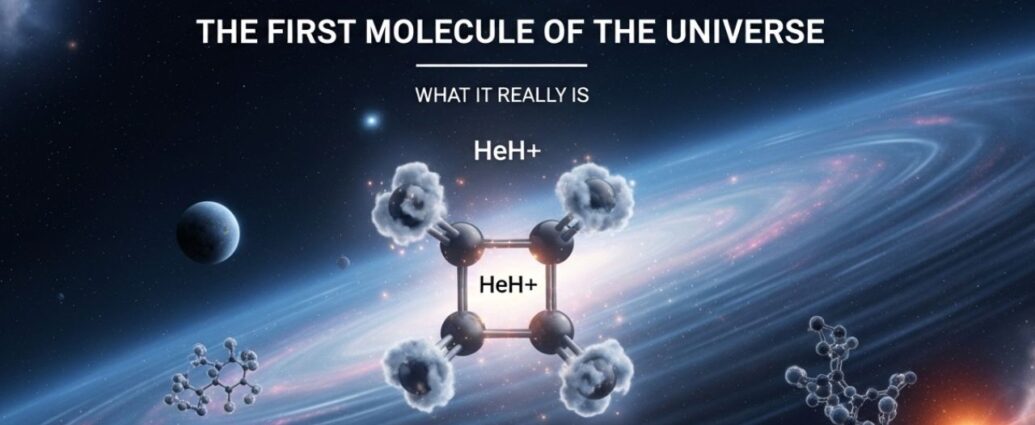
Helonium is a rare but scientifically important species — it’s another name for the helium hydride ion (HeH⁺), a positively charged molecule formed from a helium atom bonded to a hydrogen atom with one electron removed. Scientists consider helonium the first chemical compound ever formed in the universe, appearing shortly after the Big Bang. Its study helps astronomers and chemists understand cosmic evolution, early universe chemistry, and the behavior of fundamental ions in extreme environments.
The Chemistry of Helonium: Helium Meets Hydrogen
Helonium has the chemical formula HeH⁺ and is most simply described as protonated helium. In this ion:
-
A helium atom (He) and a hydrogen atom (H) share a bond.
-
One electron is missing, giving the molecule a positive charge.
-
It is isoelectronic with molecular hydrogen (H₂), meaning they have the same number of electrons, but very different properties due to the charge and components involved.
This ion is extremely reactive — much more so than most familiar chemicals — and it behaves like a strong acid in a theoretical sense. It readily donates its proton (hydrogen ion) to other molecules, which is part of why it can’t exist freely under normal Earth conditions.
Why Helonium Is Called the Universe’s First Molecule
In the earliest moments after the Big Bang, the universe was filled with hot, dense plasma. As it expanded and cooled, the first neutral atoms formed — mainly hydrogen and helium. According to astrophysical models, helonium (HeH⁺) was likely the first stable chemical compound created during this cooling phase because a proton (hydrogen ion) bonded with helium more readily than any other available particles.
Scientists had suspected helonium’s existence for decades, but it wasn’t until 2019 that researchers detected it directly in the interstellar medium, specifically in the planetary nebula NGC 7027. This confirmed a long‑held theory about early chemical evolution in space.
Physical and Chemical Properties of Helonium
Helonium is quite different from everyday molecules:
-
Strong Acidic Character: Helonium (HeH⁺) is considered one of the strongest acids known, although not in a practical laboratory sense because it cannot be isolated offline.
-
Reactivity: It reacts with many common substances, including water, oxygen, and ammonia by donating its proton.
-
Detectability in Space: It possesses a permanent dipole moment, which helps astronomers identify its spectroscopic signature — a crucial feature that enabled its detection in nebulae.
Because helium normally does not form bonds under typical conditions (noble gases are famously unreactive), helonium’s existence is a fascinating exception driven by early universe physics and extreme conditions in space.
Helonium in the Interstellar Medium
Helonium’s detection in NGC 7027 was a milestone in astrophysics. This planetary nebula, a remnant of a dying star, provided the right conditions — low density, high radiation — for HeH⁺ to exist long enough to be observed.
Astronomers use specialized telescopes capable of capturing infrared spectral lines to identify helonium, as its most prominent spectral features occur in a range that overlaps with other cosmic signatures. Detecting these lines confirmed not just the existence of helonium in space, but also supported theories of molecular formation following the Big Bang.
Scientific Importance of Helonium
Understanding Early Universe Chemistry
Helonium is key to explaining how simple atoms combined to form the first molecules in the universe. Because hydrogen and helium were overwhelmingly abundant in the primordial cosmos, HeH⁺ formation marks the earliest step in chemical complexity.
Astrophysical Modeling
By studying helonium, researchers refine models of chemical reactions in space — especially in environments lacking dust and heavy elements. These models help predict the behavior of gases in stars, nebulae, and the interstellar medium.
Spectroscopic Techniques
Helonium’s detection advances astronomical spectroscopy, helping scientists distinguish subtle molecular signals amid the cosmic “noise” of other atomic emissions. This assists in mapping cosmic structures and chemistry.
Helonium vs Everyday Chemistry
On Earth, we rarely encounter helonium because:
-
It cannot be stored, as it reacts immediately with other molecules.
-
It only exists under extreme conditions similar to outer space or in specialized laboratory settings.
In contrast, common acids like hydrochloric acid or sulfuric acid are stable in liquid form and used routinely in laboratories and industry. Helonium’s transient nature and unique reactivity make it a scientific curiosity rather than a practical chemical in everyday use.
Common Misconceptions About Helonium
Because “helonium” sounds like a playful or informal term, some people confuse it with slang or pop culture references unrelated to science. There are online memes and slang explanations that treat helonium as a humorous state of mind or an internet joke — but this has no scientific basis and is separate from the chemical definition.
Additionally, helonium is sometimes mixed up with unrelated terms or fictional uses in games or music names, but the scientifically recognized meaning refers specifically to HeH⁺, the helium hydride ion.
Conclusion:
Helonium may seem like an obscure term, but it represents a cornerstone of cosmic chemistry. As the first compound formed after the Big Bang, the helium hydride ion offers a glimpse into how atoms began to interact and form more complex structures in the universe’s earliest epochs. Its unique chemical and spectroscopic properties have made it both a challenge and a triumph for scientists seeking to understand the origins of molecular chemistry in space.
While you won’t encounter helonium in a school lab or everyday environment, its legacy lingers in the stars — a tiny, charged molecule with a massive role in the story of the universe.