
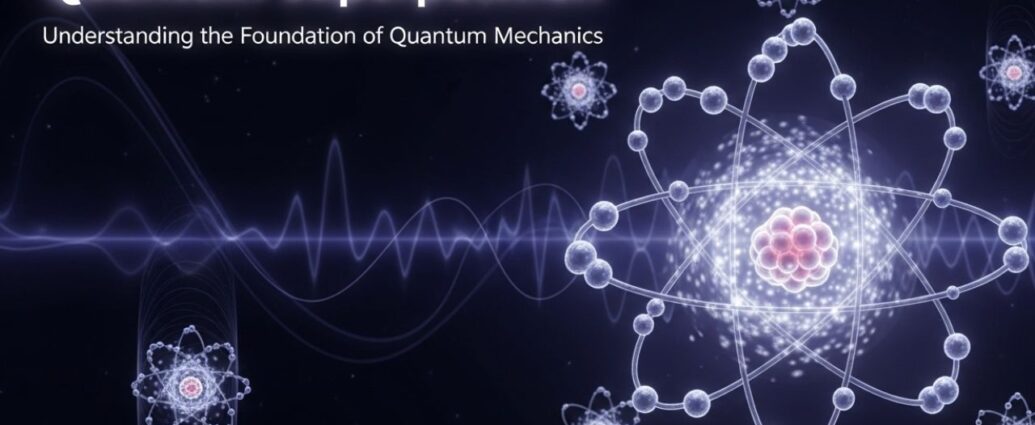
Quantum superposition is one of the most fascinating and fundamental principles of quantum mechanics. It describes a phenomenon where a quantum system can exist in multiple states simultaneously until it is measured or observed. This concept challenges classical intuition and underpins many emerging technologies, from quantum computing to quantum cryptography.
This article explores quantum superposition, its principles, applications, experiments, and implications for the future of science and technology.
What Is Quantum Superposition?
In classical physics, objects exist in a single, well-defined state at any given time. For example, a coin is either heads or tails. In contrast, quantum superposition allows quantum particles, like electrons or photons, to exist in multiple states at once.
Mathematically, if a particle can be in state |0⟩ or |1⟩, superposition allows it to be in a combination:
∣ψ⟩=α∣0⟩+β∣1⟩|\psi⟩ = \alpha |0⟩ + \beta |1⟩
where α and β are complex numbers representing the probability amplitudes of each state. Upon measurement, the system “collapses” into one of the possible states with probabilities determined by the amplitudes.
Key Principles of Quantum Superposition
-
Linear Combination of States – A quantum state can be expressed as a combination of multiple basis states.
-
Probability Amplitudes – The coefficients (α, β, etc.) determine the likelihood of observing a specific state.
-
Wavefunction Collapse – Measurement causes the system to assume a definite state.
-
Interference Effects – Superposed states can interfere, producing observable patterns in experiments like the double-slit experiment.
These principles make superposition a central feature of quantum systems and distinguish them from classical systems.
Famous Experiments Demonstrating Superposition
1. Double-Slit Experiment
The double-slit experiment demonstrates that particles such as electrons or photons can interfere with themselves, creating an interference pattern only explainable by superposition. Each particle behaves as if it passes through both slits simultaneously until measured.
2. Schrödinger’s Cat
Erwin Schrödinger proposed a thought experiment where a cat in a sealed box is simultaneously alive and dead until observed. This illustrates the counterintuitive implications of superposition on macroscopic systems.
3. Quantum Interference in Qubits
In quantum computing, qubits exploit superposition to represent both 0 and 1 at the same time, enabling parallel computation and vastly increasing computational power compared to classical bits.
Applications of Quantum Superposition
Quantum superposition is more than a theoretical curiosity; it has practical applications in emerging technologies:
Quantum Computing
Superposition allows qubits to process multiple possibilities simultaneously, enabling exponential speed-up for specific problems like factoring large numbers or searching databases.
Quantum Cryptography
Superposition, combined with entanglement, ensures secure communication protocols. Measurement of quantum states by an eavesdropper disturbs the system, revealing potential interception.
Quantum Sensors
Superposition enhances the sensitivity of quantum sensors, improving measurements in navigation, medical imaging, and material analysis.
Fundamental Physics Research
Superposition helps physicists test theories about quantum mechanics, coherence, and the boundary between classical and quantum worlds.
Challenges in Utilizing Superposition
Despite its potential, practical use of superposition faces challenges:
-
Decoherence – Interaction with the environment can destroy superposition, collapsing the system prematurely.
-
Error Correction – Maintaining stable superposition in qubits requires advanced error-correcting techniques.
-
Measurement Limitations – Observing a superposed state collapses it, limiting direct access to all information simultaneously.
Overcoming these challenges is essential for advancing quantum computing and related technologies.
Theoretical Implications of Superposition
Quantum superposition challenges classical intuitions about reality:
-
It suggests particles do not have definite properties until measured.
-
It introduces the concept of parallel possibilities existing simultaneously.
-
It raises questions about the role of the observer in determining physical outcomes.
These implications have philosophical as well as scientific significance, influencing interpretations like the Copenhagen interpretation, many-worlds theory, and decoherence theory.
Future of Quantum Superposition
Superposition remains a key area of research and innovation:
-
Scalable Quantum Computers – Exploiting superposition for more complex algorithms.
-
Quantum Networks – Utilizing superposition and entanglement for global quantum communication.
-
Advanced Quantum Simulations – Modeling complex systems in physics, chemistry, and materials science.
-
Exploring Quantum-Classical Boundaries – Understanding how macroscopic objects might exhibit quantum behavior.
Continued progress in controlling and sustaining superposition could revolutionize technology and deepen our understanding of the universe.
Conclusion
Quantum superposition is a cornerstone of quantum mechanics, demonstrating that particles can exist in multiple states simultaneously until measured. Its applications in quantum computing, cryptography, and sensing make it one of the most exciting areas of modern science. Despite challenges like decoherence and measurement limitations, superposition continues to inspire research, innovation, and philosophical debate. Understanding and harnessing superposition could unlock unprecedented technological advancements and reshape our understanding of reality itself.