
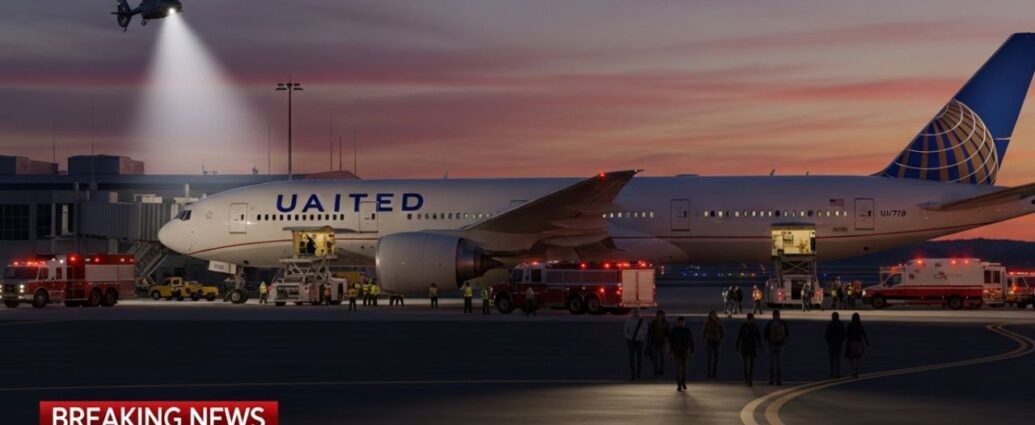
The United Airlines Flight UA770 emergency diversion captured significant public attention when a routine Barcelona to Chicago route turned into a high‑priority in‑flight event. Midway over European airspace, pilots declared a precautionary emergency and diverted the flight to a nearby major airport, triggering safety protocols and rapid coordination with air traffic control. This article explores the full story behind the United Airlines Flight UA770 emergency diversion — from initial flight operations to the safe landing and what the event reveals about aviation safety today.
The Flight Plan and Unexpected Turn
Scheduled Route of United Airlines Flight UA770
United Airlines Flight UA770 originally departed Barcelona El Prat Airport (BCN) with a scheduled arrival at Chicago O’Hare International Airport (ORD). The flight was operated by a Boeing 787‑9 Dreamliner, one of the more advanced long‑haul aircraft in United Airlines’ fleet.
Passengers boarded without any indication that their journey would be anything other than routine. Initial climb, cruising altitude, and early communication with air traffic control were all normal. However, as with any long‑distance flight, unforeseen conditions can arise — sometimes requiring immediate action from the flight crew.
What Triggered the Emergency Diversion
About halfway into the transatlantic crossing, the cockpit crew detected a situation requiring attention. Reports indicate that the pilots activated the international aviation emergency code (squawk 7700) to signal a general emergency to air traffic control. While specific technical details were not fully disclosed by the airline, press accounts point to a precautionary measure taken due to a technical irregularity or potential safety concern.
Declaring an emergency in the skies does not inherently imply immediate danger. Instead, it signals that the crew needs priority handling and may require a landing at the closest suitable airport for further inspection or safety assurance. In this case, controllers quickly diverted UA770 to a major airport with proper emergencyservices standing by.
Emergency Diversion and Safe Landing
The Diversion Decision and Route Change
When the United Airlines Flight UA770 emergency diversion was executed, the flight was steered toward London Heathrow Airport (LHR) — one of Europe’s busiest and best‑equipped airports. Air traffic control prioritized the flight’s arrival as safety crews prepared for any potential scenario.
As the aircraft descended for landing, passengers were informed of the situation in a calm and professional manner by the cockpit crew. Flight attendants helped cultivate an atmosphere of assurance and order, adhering to training protocols designed for exactly these kinds of unplanned events.
Touchdown and Passenger Experience
Thankfully, the United Airlines Flight UA770 emergency diversion concluded with a safe landing on Heathrow’s runway. Emergency teams, including fire and medical personnel, were present as a standard precaution. No injuries were reported, and the aircraft was brought to a controlled stop at the terminal.
Inside the cabin, passengers described nervousness mixed with relief. In moments like this, the professionalism of the airline crew becomes especially apparent: announcements were clear, reassurance was constant, and the cabin environment remained composed even amid anxiety.
Once on the ground, passengers disembarked safely, helped by airline ground staff who were ready to assist with onward travel arrangements. United Airlines also provided support services — including refreshments, accommodations when needed, and rebooking updates — to ensure travelers were taken care of following the unexpected event.
Understanding Emergency Diversions
Why Diversions Happen
The United Airlines Flight UA770 emergency diversion highlights an important aspect of aviation: diversions are not necessarily indicators of catastrophic failure. Instead, they often reflect a precautionary decision made to ensure the well‑being of everyone on board.
Diversions can be triggered by a range of factors, including:
-
Technical irregularities or system warnings that could pose future complications if the flight continued.
-
Medical emergencies involving passengers or crew that require immediate landing and care.
-
Weather or environmental conditions that make continuing a planned route unsafe.
-
Security concerns that mandate immediate and controlled response.
Regardless of the cause, modern aviation systems are structured around layered redundancies — meaning pilots, automated systems, and controllers all work together to find the safest solution.
The Role of Flight Crew and Safety Protocols
One of the most reassuring aspects of incidents like the United Airlines Flight UA770 emergency diversion is the professionalism of flight crews and airline safety protocols. Pilots are trained to assess rapidly evolving data, consult with air traffic control, and make decisions that prioritize life and aircraft integrity over schedule.
Cabin crews also undergo rigorous preparedness training, allowing them to support passengers emotionally and logistically during unexpected changes. Their role in maintaining calm and order — from announcements to seating adjustments — plays a critical part in how these scenarios unfold.
Impact on Passengers and Lessons for Travelers
Passenger Reactions to the Diversion
Travelers aboard the United Airlines Flight UA770 emergency diversion experienced a range of emotions. Some were anxious, whispering and exchanging nervous glances. Others found comfort in knowing seasoned professionals were navigating the situation. Flight attendants helped diffuse tension through calm communication and confidence‑inspiring action.
When the aircraft reached the ground successfully, moments of relief — and even joy — were evident among passengers who had braced for the unknown. This mix of fear, resilience, and gratitude is typical in diversions that end safely.
Lessons for Future Flyers
A key takeaway from the United Airlines Flight UA770 emergency diversion is that aviation safety systems work as intended. These devices and protocols exist precisely to prevent escalation of potential problems. For travelers, it is crucial to:
-
Follow crew instructions carefully.
-
Stay informed through official announcements.
-
Understand that diversions prioritize safety over travel timelines.
Modern aircraft are marvels of engineering, equipped to handle anomalies with precision and adaptability. Incidents like this reaffirm that safety remains the cardinal rule of air travel — even when plans shift unexpectedly.
Conclusion:
The story of the United Airlines Flight UA770 emergency diversion is not about failure — it’s about preparedness, professionalism, and the resilience of commercial aviation. From the moment the crew detected an anomaly, the systems worked as designed, leading to a safe diversion and successful landing.
Today’s travelers can draw confidence from how UA770 was handled — by trained pilots, attentive cabin crew, and coordinated safety teams on the ground. In aviation, the unexpected can always arise, but the industry’s safety culture ensures that every possible measure is taken to protect passengers and crew alike.